

2026-08-14 11:29:08
Shielded twisted pair (STP) cable and unshielded twisted pair (UTP) cable both carry data over twisted copper pairs, but the right choice comes down to one question: how much electromagnetic interference will the cable be exposed to? STP wraps the twisted pairs in a metallic shield to block EMI and RFI in electrically noisy environments such as factories, data centers, and hospitals, while UTP skips that layer for a lighter, more flexible, and lower-cost cable suited to standard office and home networking. This guide compares both cable types across shielding, cost, installation, and real-world applications to help you decide which one fits your project.
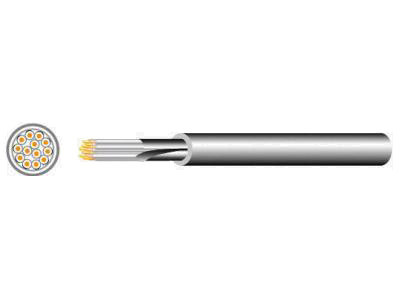
UTP cable consists of insulated copper pairs twisted together with no additional shielding layer. The twisting itself cancels out a portion of external noise, which is why UTP performs well in typical office and residential settings where electrical interference is minimal.
No metallic shield, so the cable is thinner, lighter, and easier to route through walls and conduits
No grounding required at termination, which simplifies installation
Lower material and labor cost than shielded alternatives
Widely used in Cat5e, Cat6, and Cat6a office and home Ethernet runs
More flexible and easier to bend around tight corners
Trade-off: UTP has little defense against EMI from motors, fluorescent ballasts, or high-voltage power lines run in parallel, so signal quality can degrade in electrically noisy environments.
STP Cable adds a conductive layer, usually a braided copper mesh, aluminum foil, or a combination of both, around the twisted pairs. This shield acts like a Faraday cage: it diverts ambient electromagnetic noise to ground and keeps the cable's own signal emissions from leaking out and interfering with nearby equipment.
Foil shielding (F/UTP) covers all pairs with a thin metallic layer for moderate EMI protection at lower cost
Braided shielding (S/STP) offers stronger, more durable protection and better handles physical flexing
Individually shielded pairs (S/FTP) protect against both external interference and crosstalk between pairs inside the same cable
Requires proper single-point grounding to avoid ground loop issues
Typically 25-40% heavier and larger in diameter than equivalent UTP cable
Need a shielding configuration matched to your EMI environment? Send us your application details and pair count, and our engineering team can recommend a construction within 24 hours.
| Factor | UTP Cable | STP Cable |
|---|---|---|
| EMI/RFI immunity | Low, relies on twist rate only | High, metallic shield blocks external noise |
| Grounding needed | No | Yes, one end only to prevent ground loops |
| Cable weight/diameter | Lighter and thinner | 25-40% heavier, larger diameter |
| Installation complexity | Simple, no grounding steps | Requires correct termination and grounding practice |
| Cost | Lower material and labor cost | Higher due to shield material and grounding labor |
| Typical environment | Offices, homes, standard commercial buildings | Factories, data centers, hospitals, outdoor/industrial sites |
UTP is the practical choice whenever the installation environment has little electrical noise and budget or cable weight matters:
Standard office and home Ethernet networks
Retail and commercial buildings without heavy machinery nearby
Projects where minimizing cable weight and installation time is a priority
Budget-sensitive cabling runs where EMI risk is low
STP earns its higher cost whenever the cable run shares space with sources of electrical noise or the application cannot tolerate signal degradation:
Factory floors with variable frequency drives, motors, or heavy machinery (Profinet, EtherCAT, Modbus installations)
Hospitals and medical facilities, especially near MRI rooms and patient monitoring networks
Data center server-to-switch connections and high-density SAN backbones
Outdoor or industrial runs exposed to nearby high-voltage power lines
Broadcast and professional A/V installations requiring clean, interference-free signal paths
If your project falls into any of these categories, tell us your pair count, AWG, and shielding preference (foil, braid, or combination) — we'll quote a custom shielded cable build for your specification within one business day.
The core difference is the metallic shielding layer around the twisted pairs. STP includes it for EMI/RFI protection; UTP does not, relying only on the twist itself to cancel noise.
Yes. The shield should be grounded at one end only. Grounding both ends can create a ground loop that introduces its own noise into the signal path.
Choose STP whenever the cable route passes near motors, VFDs, high-voltage lines, or other strong EMI sources, or when the application (medical imaging, industrial control, broadcast) cannot tolerate any signal interference. For the technical standards behind high-speed data transmission over these cable types, see our guide on Which Standard Defines Gigabit Ethernet Over Twisted Pair Copper Wire.
Technically yes, but shielding effectiveness only holds if every component in the link — cable, connectors, and patch panels — is shielded and properly grounded. Mixing shielded cable with unshielded connectors breaks the shield continuity and negates the EMI

Specializing in the production of wire and cable Hong Kong funded enterprises (both domestic and foreign sales); has won the IS09001-2000 international quality certification and the United States UL safety certification, is a professional wire manufacturers.
Tel: +86-769-8178 1133
Mobile: +86-13549233111
E-mail: andy@herwell.com.cn
Add: No.13 Shui Chang Er Road, Shui Kou Village, Dalang Town, Dongguan City, Guangdong Province, China


